





Learning integers makes people comprehend math and is practical in real life. Integers are used to describe real numbers, such as the money in a bank account that is in profit or loss, the temperature above or below 0, the height above or below sea level, and the score in a game.
Lack of knowledge about integers makes individuals unable to read and solve real-life mathematical tasks that require numbers (Van de Walle, Karp, and Bay-Williams, 2019). In most education systems, the topic of integers is formally taught in lower secondary or lower middle school, typically in Grade 7 or Grade 8. Integer is an important topic in the Form One math curriculum in Malaysia, and it serves as a foundation for the subsequent topics like algebraic expressions, equations, and functions. Mastery of integer operations is thus a key to future success in mathematics learning (Malaysian Ministry of Education, 2018). This level is where the students are supposed to know and perform the four basic arithmetic operations, which include addition, subtraction, multiplication, and division using positive and negative integers.
Although integers are essential, integer operations are difficult to learn to many students. One of the reasons is that negative integers are abstract and do not have direct physical counterparts in our daily life (Bofferding & Wessman-Enzinger, 2017). Natural numbers can be associated with counting numbers, and negative integers require students to consider the amount that represents a lack, deficit, or direction. Research indicates that students tend to misinterpret the meaning of negative integers, as well as apply incorrect rules whenever they handle mixed signs (Bofferding, 2010; Vlassis, 2004). In one instance, a student may believe that subtraction is always seen to make the number smaller or multiplication is always seen to make the number larger, and these misconceptions will continue to lead to perpetual mistakes that occur when working with negative integers.
Students find it difficult to learn the operations of integers. It is hard to imagine negative integers; they are not observed in real life (Bofferding and Wessman-Enzinger, 2017). Natural numbers are simple since we can count things, but negative integers imply the absence of things, debt, or direction, which is more abstract. A lot of research demonstrates that negative integers are frequently misunderstood by students and apply incorrect rules when performing operations involving mixed signs (Bofferding, 2010). Indicatively, students believe that when you subtract a number, it will become smaller or when you multiply a number, it will become bigger. These misconceptions lead to recurrent errors with negative integers. Previous research has consistently shown that students have more difficulty working with numbers of mixed signs, particularly subtraction and division, compared to operations involving only positive integers (Altiparmak & Ozdogan, 2010; Lim, 2010). Most students recall the rules such as “minus times minus is equal to plus,” by heart, but they fail to comprehend the reasons behind their effectiveness, resulting in fragile knowledge that is easily forgotten.
Successful learning of math requires the use of teaching strategies that emphasize conceptual understanding, systematic assistance, and continuous feedback. The students require straightforward guidance that will bring them progressively from basic identification of integers to applying integer rules in increasingly complex problem-solving situations. The importance of immediate feedback allows the students to detect their errors, refine their understanding, and correct misconceptions during the learning process (Shute, 2008). Thus, an online tutoring program offers a good alternative. It provides the personal assistance, immediate feedback, and information that enables teachers to view the strengths and weaknesses of each student’s mastery of integers.
This study thus aims to provide a diagnostic profile of the item difficulty of each combination of integer operations in the Online Tutoring Program (OTP). It provides actual evidence regarding the learning issues and teaching requirements of students.
Methodology
We employed quantitative research to provide a diagnostic profile of the item difficulty for the basic arithmetic operations of integers. The descriptive and inferential survey design was suitable for us since it is ideal for observing the pattern of student performance and identifying the difficulty of each question in each task. This study involved 88 Form One students (13-14 years old) in two rural secondary schools in Baling District, Kedah State, Malaysia. We selected rural schools to get to know students who might lack additional learning assistance.
We began constructing the OTP using a framework that involves personalized learning, adaptive assessment, and immediate feedback. The content was designed based Form One maths curriculum and in line with the Standard Curriculum and Assessment Document (DSKP) of the Malaysian Ministry of Education. To ensure that the content was accurate, we had the content reviewed and approved by a panel of six experienced secondary math teachers who were experts in the area of curriculum and assessment.
There were eight tasks in the OTP, which consisted of four categories of integer combinations: positive-positive, positive-negative, negative-positive, and negative-negative. These were combined with two groups of basic operations, namely addition/subtraction and multiplication/division. Four items were of varying difficulty in each task. In item 1, students were asked to identify and name the integers. Focused on performing simple operations in item 2. Question 3 applied integer rules to real-life problems. In item 4, students were required to solve new or longer problems using the same concept. (Refer Figure 1).
Figure 1

All eight tasks were embedded in real-life scenarios to ensure that students would understand the importance of integer operations. Students receive immediate feedback on their responses (Refer to Figure 2). If the response is wrong, they could identify the mistakes and revise their knowledge before proceeding to the next item.
Figure 2

We used the Rasch model to analyze the responses of students with the WINSTEPS software 3.71.01
Findings
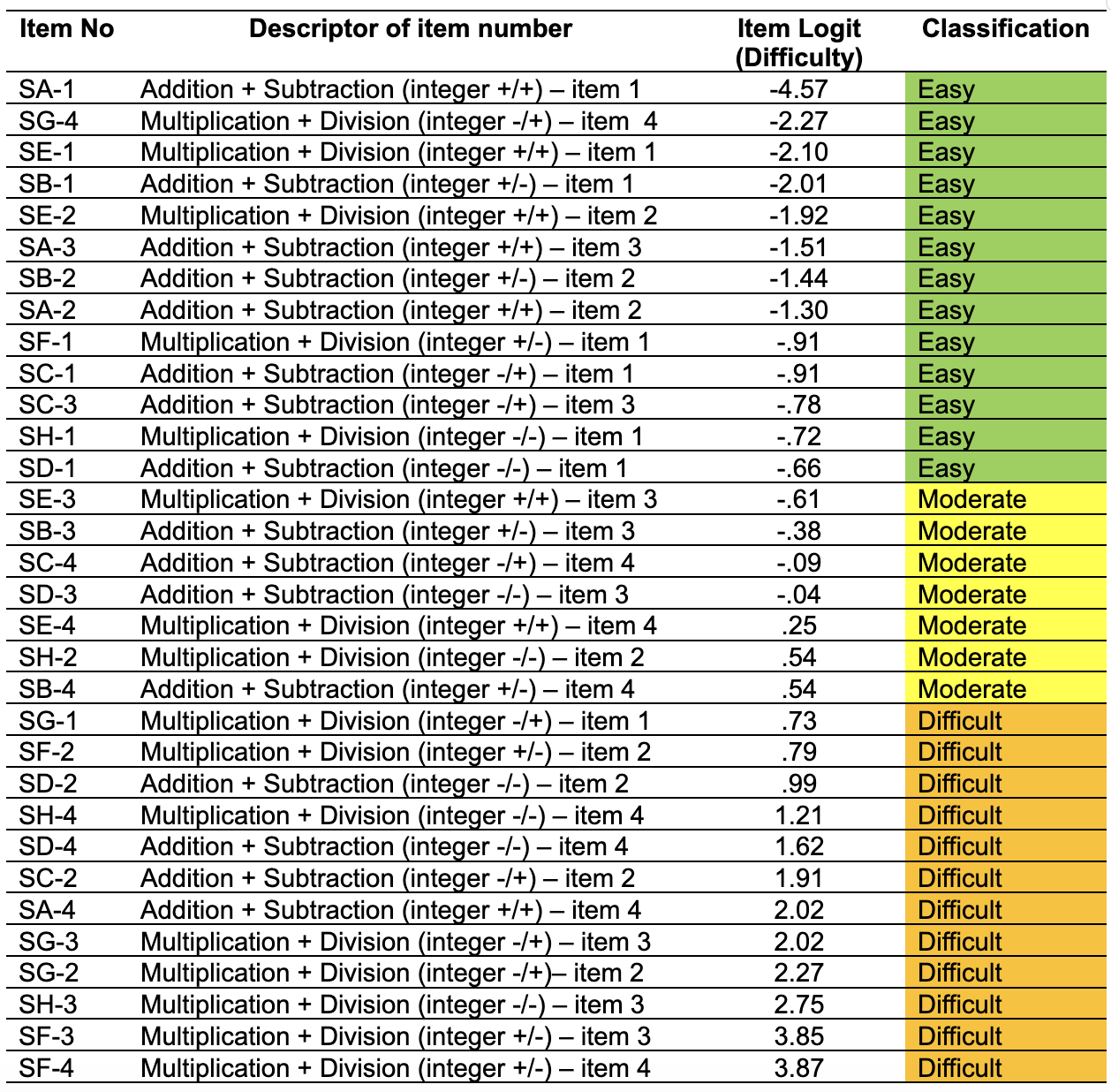
The mean logits and its standard deviation (SD) were used to look at item difficulty as proposed by Sumintono and Widhiarso (2015). The mean difficulty of items in the study was fixed to 0.00 logits with SD of 1.63 logits. Based on these figures, we divided items into three categories: difficult (logit > +1.63), moderate (between -1.63 and +1.63), and easy (logit < -1.63). Based on Table 1, we discovered that there were 12 difficult, 7 moderate and 13 easy items.
There were definite trends in the pattern of item difficulty among various combinations of integer operations. Problems that simply required identification and same-sign operations, particularly addition and subtraction of positive integers, were generally simple. In contrast, items requiring multiplying and dividing with mixed signs or negative-negative combinations, particularly at higher levels of application, were more commonly problematic.
Table 1
Classification of the item difficulty
Discussion and Conclusion
Simple integer operations, such as addition and subtraction of whole numbers, were easily done by learners in this category. They had difficulties with more abstract tasks, e.g., multiplying and dividing negative integers. This finding is consistent with what we already observed in the previous studies, namely, students feel more comfortable when the problems are in the form of normal whole-number computation. The moderate items were typically encased within real-life situations that required the application of the integer rules. As an example, identifying and performing simple addition/subtraction was relatively easier, but multiplication and division with negative values turned out to be more difficult concept, which agrees with previous results (Hanifa et al., 2024).
The high score in the easier items serves to remind us that it is important to know whole numbers first before learning about integers. However, in cases where the problems were real-life or mixed-sign multiplication and division, it was not sufficient to know that at an early age. Students required greater conceptual knowledge which could not be offered by mere procedures.
The Online Tutoring Program (OTP) is a tool that might be helpful in the case of adding immediate feedback to it. Feedback assists students in thinking more critically and manage their learning. This research did not examine all the effects that feedback alters learning gains, but the trends observed in the Rasch map can assist teachers in customizing instructions. Such hints are particularly useful when teachers do not have much time to assess.
The findings are also consistent with other trends in math education. According to researchers, it is important to construct concepts using physical tools and visual aids such as number lines and manipulatives (Instructional Science, 2025). Experiments with interactive number lines are new and reveal that the actions and visual aids, rather than abstract symbols, can assist students in comprehending integers. Online learning can be enhanced by these complementary approaches.
This study indicates that an online tutoring program, together with the analysis of the Rasch model can determine the problems students have in incremental operations. It also provides useful teaching and curriculum design concepts. The various patterns of difficulty indicate the necessity of conceptual support in online learning. Future studies may need to examine the longitudinal learning outcomes and the effectiveness of representational supports such as number lines and manipulatives with digital feedback systems.
References
Altiparmak, K., & Özdoğan, E. (2010). A study on the teaching of integers. International Journal of Mathematical Education in Science and Technology, 41(3), 331–346. https://doi.org/10.1080/00207390903308358
Bofferding, L. (2010). Negative integer understanding: Characterizing first graders’ mental models. Journal for Research in Mathematics Education, 41(5), 536–571.
Bofferding, L., & Wessman-Enzinger, N. (2017). Subtraction involving negative intergers: Connecting reasoning to instruction. Mathematics Education Research Journal, 29(2), 165–190.
Hanifa, U. N., Prabawanto, S., & Fatimah, S. (2024). Identification of the difficulties of middle school students in understanding the mixed operations of integers. KnE Social Sciences. https://doi.org/10.18502/kss.v9i13.15956 knepublishing.com
Instructional Science. (2025). Walking the number line: towards an enactive understanding of integer arithmetic. 53, 657–677. https://doi.org/10.1007/s11251-025-09707-w Springer Link
Lim, K. H. (2011). Addressing the multiplication makes bigger and division makes smaller misconceptions via prediction and clickers. International Journal of Mathematical Education in Science and Technology,42(8), 1081-1106. https://www.researchgate.net/publication/233294366_Addressing_the_multiplication_makes_bigger_and_division_makes_smaller_misconceptions_via_prediction_and_clickers [accessed Jan 09 2026].
Malaysian Ministry of Education. (2018). Dokumen Standard Kurikulum dan Pentaksiran Matematik Tingkatan 1. Bahagian Pembangunan Kurikulum.
Middleton, J. A., & Spanias, P. A. (1999). Motivation for achievement in mathematics. Review of Educational Research, 69(1), 65–88.
Shute, V. J. (2008). Focus on formative feedback. Review of Educational Research, 78(1), 153–189.
Sumintono, B., & Widhiarso, W. (2015). Aplikasi model Rasch untuk penelitian ilmu-ilmu sosial. Trim Komunikata.
Van de Walle, J. A., Karp, K. S., & Bay-Williams, J. M. (2019). Elementary and middle school mathematics: Teaching developmentally (10th ed.). Pearson.